Availability and management of water resources

According to the ONU, by 2050, at least ¼ of the population will be affected by persistent and recurring water shortages.

Increased consumption, coupled with an undervaluation of water, inadequate governance arrangements and weak enforcement, is leading to the depletion of water resources at an unprecedented rate. Climate change puts another set of pressures on this rapidly changing context: how efficient is water management? How fair is the water trade?

Sustainable Development Goal 6, among the 17 targets of the Agenda 2030, focuses on critical issues and future goals regarding global water resources. By analysing the current scenario, this research aims to map the availability and management of water resources worldwide.

Data collected by various monitoring organisations focus on the SDG regions most at risk regarding water stress.

Nine years until the end of the Agenda 2030, which geographical areas are currently experiencing the most critical situation?

Water Stress (Source: World Resource Institute, global water stress dataset retrieved in 2019, water stress by sectors dataset retrieved in 2015)

Global Water Stress Domestic Water Stress Irrigation Water Stress Livestock Water Stress Industrial Water Stress

FINDINGS

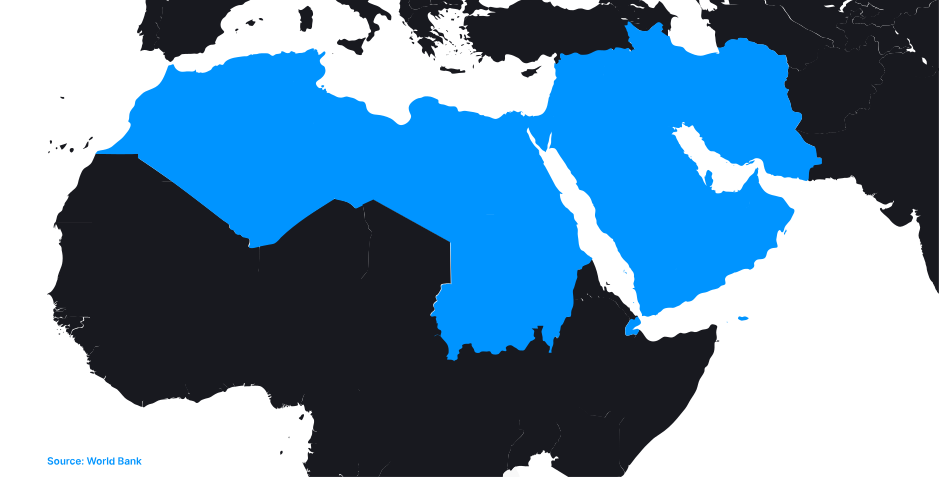
The global scenario shows that a risky situation is evident in the Middle East and North Africa region.

According to Wordbank's Beyond Scarcity: Water Security in the Middle East and North Africa report (2018), the region includes 17 countries below the ONU-defined water scarcity threshold.

What affects this index so negatively? And why in these regions?

Internal reasons, such as climatic conditions or restricted resources, and external causes, such as continuous population growth, influence water scarcity.

An increase in demand due to the constantly growing population index and morphological reasons influenced by geographical location and climate leads to the depletion of water resources - especially groundwater - at an unprecedented rate.

References
BIBLIOGRAPHY

-> Hofste, K., S. Kuzma, S. Walker, E. Sutanudjaja, M. Bierkens, M. Kuijper, M. Faneca Sanchez, et al. “Aqueduct 3.0: Updated Decision-Relevant Global Water Risk Indicators”. WRI Publications, 2019

-> Intelligent Energy, “Guidelines for the regulation of desalination”

-> ITOPF, “Oil Tanker Spill Statistic 2018”, 2019

-> Joseph Cresko. “Bandwidth Study on Energy Use and Potential Energy Savings Opportunities in U.S. Seawater Desalination Systems”

-> Natis Beyond Banking, “Desalination: balancing the Socioeconomic Benefits and Environmental Costs”

-> Rao, Prakash, Arian Aghajanzadeh, Paul Sheaffer, William R. Morrow, Sabine Brueske, Caroline Dollinger, Kevin Price, Prateeti Sarker, Nicholas Ward, e Joe Cresko. “Survey of Available Information in Support of the Energy-Water Bandwidth Study of Desalination Systems”, 2016

-> Reig, P., T. Luo, E. Christensen, e J. Sinistore. “Guidance for Calculating Water Use Embedded in Purchased Electricity”, 2020

-> World Bank. “Beyond Scarcity: Water Security in the Middle East and North Africa”. The Role of Desalination in an Increasingly Water-Scarce World. World Bank, 2019

-> World Bank Group “The role of desalination in an increasingly Water-Scarce World”, 2019

-> SABMiller, WWF, “Water Footprinting: identifying & addressing water risks in the value chain”

SITOGRAPHY