
If I told you that each e-mail you send is made of 361 litres of water? -> Drop down
Verify your water consumption THE ONLY TOOL THAT CONVERT YOUR ONLINE ACTIONS IN LITRES OF WATER

Data centres provide online searches, web advertising and cloud services. They are energy-efficient and environmentally friendly, but there is a hidden cost: these facilities use billions of liters of water.

These massive computer-filled warehouses are usually located close to large population hubs to help its web services respond quickly.The processing units inside heat up quickly, and water is needed to cool them down.

Think about how often you hear the fans of your computer spinning. This is because the device is overheated and needs to draw in outside air to reduce its temperature.

The same happens in data centers, just at a much larger scale. Chillers exchange the internal heat with the cooler external environment, or air is drawn in and then cooled down. A 1MW data center using traditional cooling can use around 25.55 million litres of water per year.
Sustainability Dashboard IMPROVE YOUR WATER FOOTPRINT Track your impact We’re not magicians, however we make the invisible visible.
What are you waiting for?! Let’s drop down.
Feel guilty What level of consumption do you belong to: bathtub, bus or monumental level? Well, now think how many other things you could have done with all this water!
Upgrade ASAP Feel it closer to the end of the planet? Not the last wor(l)d though, don’t sink it!
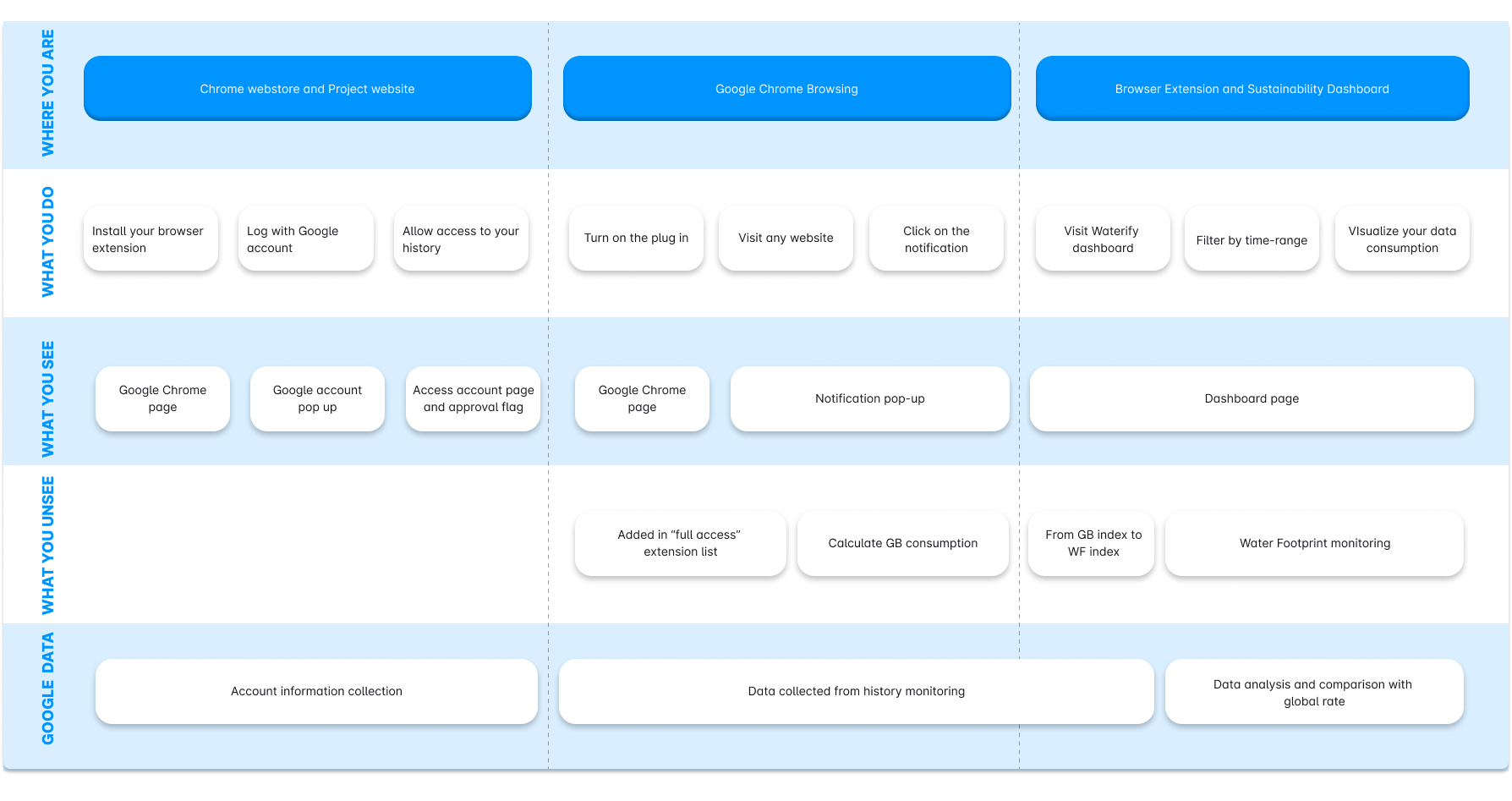
How Waterify works HOW WE COLLECT AND MANAGE YOUR DATA
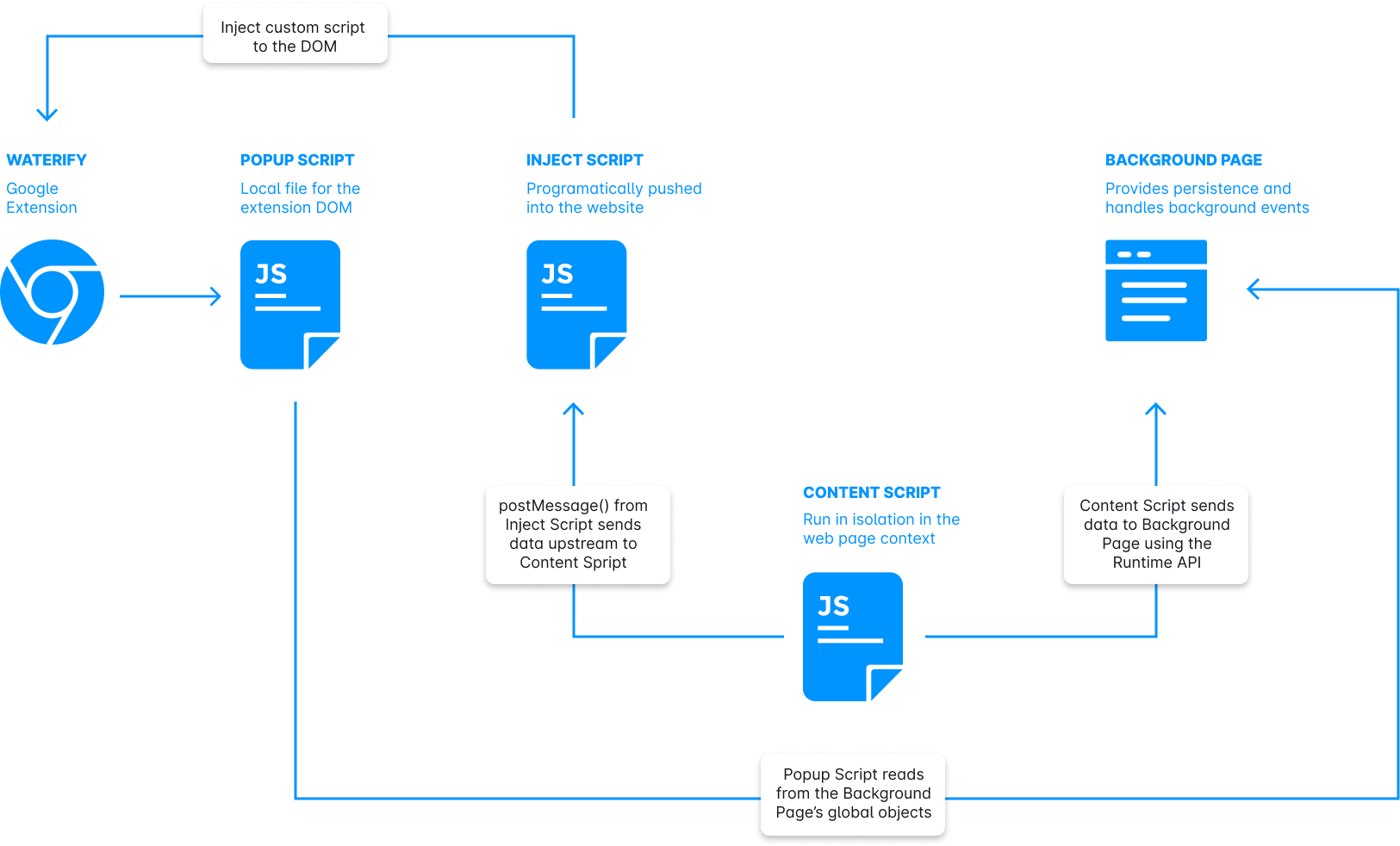
HOW WE PROCESS YOUR DATA
References
BIBLIOGRAPHY

-> Hofste, K., S. Kuzma, S. Walker, E. Sutanudjaja, M. Bierkens, M. Kuijper, M. Faneca Sanchez, et al. “Aqueduct 3.0: Updated Decision-Relevant Global Water Risk Indicators”. WRI Publications, 2019

-> Intelligent Energy, “Guidelines for the regulation of desalination”

-> ITOPF, “Oil Tanker Spill Statistic 2018”, 2019

-> Joseph Cresko. “Bandwidth Study on Energy Use and Potential Energy Savings Opportunities in U.S. Seawater Desalination Systems”

-> Natis Beyond Banking, “Desalination: balancing the Socioeconomic Benefits and Environmental Costs”

-> Rao, Prakash, Arian Aghajanzadeh, Paul Sheaffer, William R. Morrow, Sabine Brueske, Caroline Dollinger, Kevin Price, Prateeti Sarker, Nicholas Ward, e Joe Cresko. “Survey of Available Information in Support of the Energy-Water Bandwidth Study of Desalination Systems”, 2016

-> Reig, P., T. Luo, E. Christensen, e J. Sinistore. “Guidance for Calculating Water Use Embedded in Purchased Electricity”, 2020

-> World Bank. “Beyond Scarcity: Water Security in the Middle East and North Africa”. The Role of Desalination in an Increasingly Water-Scarce World. World Bank, 2019

-> World Bank Group “The role of desalination in an increasingly Water-Scarce World”, 2019

-> SABMiller, WWF, “Water Footprinting: identifying & addressing water risks in the value chain”

SITOGRAPHY