MENA local water resources management

As shown by visualization, the MENA region mainly exploits non-renewable resources: surface water and groundwater. As traditional resources are bound to disappear due to the high level of water stress in this region, alternative water resources increasingly gain ground.

Although many countries in the region rely on these traditional resources, others - such as Gulf countries - turn more attention to unconventional water resources, such as desalination and wastewater recycling.

Nevertheless, what are the most exploited alternative water withdrawal resources in the MENA region?

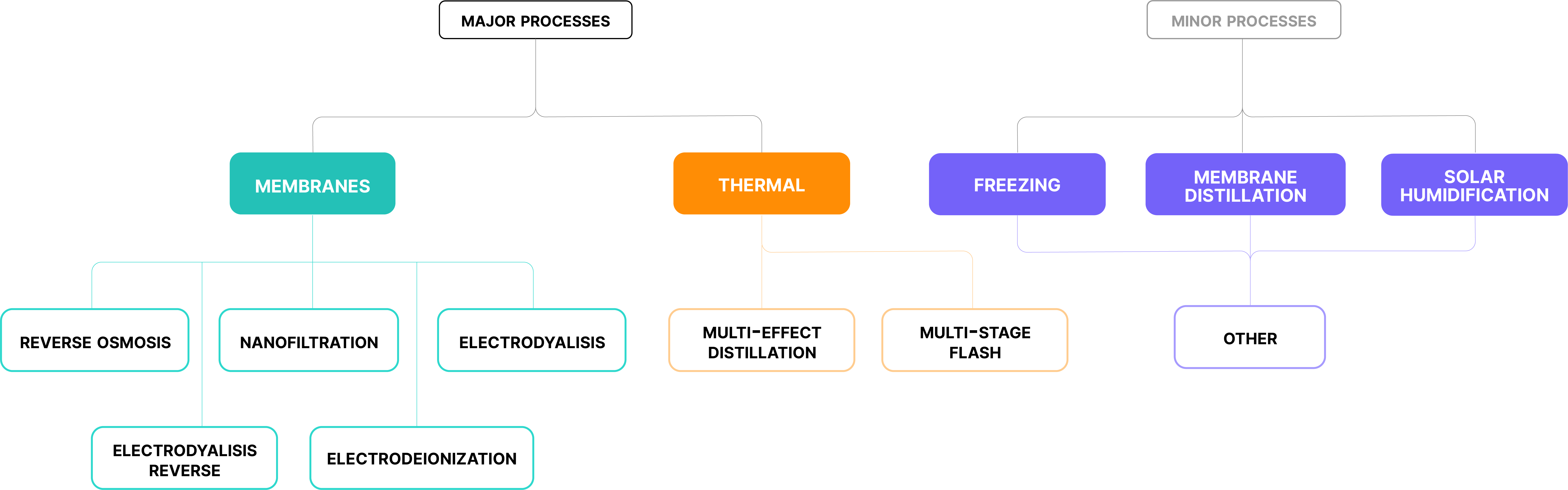
Globally, desalination is the most exploited alternative water withdrawal resource in MENA's region. What is this process? It is a process that removes the excess salt and other minerals from water to obtain fresh water through minor and major processes:

Understanding the different technologies in this process is important because, depending on the type of feedwater used, it is possible to define the water recovery ratio, which indicates the proportion of intake water converted into high quality (low salinity) water for sectoral use. The water recovery ratio results from the correlation of feedwater and desalination technology in the matrix plot below.

According to this index, brine as feed water is associated with the lowest water recovery ratios, regardless of the applied technology, except for electrodialysis. This technology recovers most of the supplied water. Since this index is so highly variable depending on the technologies and the type of feedwater, two questions arise:

Which type of feedwater is the most exploited? And which technology among the main processes is the most exploited?

FINDINGS

Desalination of seawater appears as a possible solution for the water scarcity problem in the Middle East and North Africa region. Currently, the reverse osmosis (RO) method is the preferred desalination process mainly due to the low energy and space consumption and the reduction in the cost of the potable water obtained.

Studies have shown that this activity may cause some environmental impacts, mainly generated by the discharge into the sea of the brine produced - water saturated or strongly impregnated with common salt. Due to the density difference between brine and seawater, the brine discharged into the sea will induce a stratified system, with brine forming a bottom layer that can affect the benthic communities that usually live in stable salinity environments.

Is this trend present in all SDGs regions?

FINDINGS

The Middle East and North Africa region has the highest level of brine production from seawater desalination in the world, followed by the East Asia and Pacific region. Also, the visualization shows a massive gap between the MENA values in terms of brine production, desalination capacity and plants compared to the other areas.

A problem emerges in the management of production waste: there is a significant discrepancy between desalination capacity (%) and brIne production (%). It means that the brine wastewater is greater than the amount of clean water generated by the seawater desalination process.

In addition, the graph shows a water overproduction in the region of MENA compared with the other ones, where the desalination plants and capacity have a similar value.

The Middle East and North Africa region hosts the most significant number of desalination plants. Where exactly are they located?

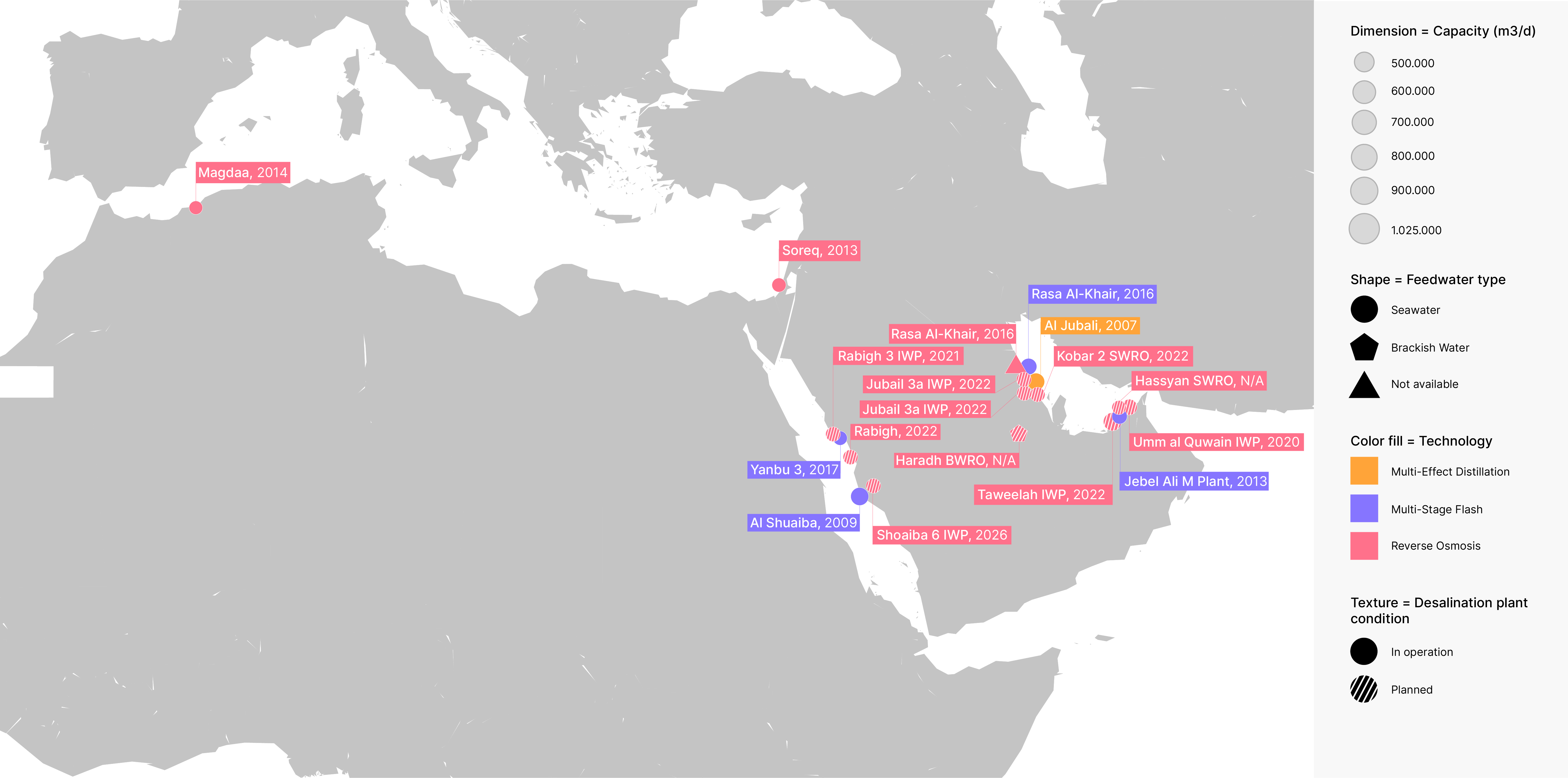
The major desalination plants in Middle East and North Africa (Source: Science Direct, dataset retrieved in 2018)

FINDINGS

The interactive map reveals the spatial distribution and size of the largest desalination plants in the MENA region operating under different feedwater-technology combinations. Except for a few plants, most are located in the Gulf countries and, more specifically, in Saudi Arabia and the United Arab Emirates. Indeed, these two countries have been experiencing economic and demographic growth in recent years, forcing them to find solutions - not always sustainable - to meet the growing demand for water to support this expansion.

The map shows existing plants and those under construction; in both cases - as already noted in the analysis of previous data - the most used desalination technology is reverse osmosis. The most used type of feedwater is seawater. This situation is also confirmed by looking specifically at the situation in Saudi Arabia and UEA.

Which are the most exploited desalination technologies in Saudi Arabia and United Arabia Emirates?
The majority of desalination plants take place along the coast. Is there a correlation between desalination plants distance to coastline and brine production?

FINDINGS

The geographical location of brine production influences the technical viability of different methods of brine disposal:

  1. Almost 50% of brine production occurs in desalination plants located less than 1 km from the coast.
  2. The desalination plants located between 10 and 50 km from the coast record the lowest amount of brine produced.

Against this backdrop, the situation in the MENA region appears critical. Although they have exhausted their water resources, the alternative solutions adopted do not improve the environmental impact on our planet.

What if the SDGs will not achieve? What if the MENA situation starts to show in other regions of the world? Moreover, if local water resources run out, what external resources will countries use?

-> MENA water trade